How much do People use Confirmation Language with Generative AI?
Brief Report November 23, 2026 by Clint McKenna
People commonly use generative AI to seek information about important social topics. When using LLM chatbots, what is the rate of confirmation language relative to falsifying or neutral language? While it is common to engage in confirmation bias, this might lead to a flawed view of reality. Thinking about why one might be wrong about their beliefs can be a good exercise in understanding why they think the way they do.
Confirmation language is characterized by using a leading question to confirm one’s existing belief, whereas falsifying language will try to disconfirm one’s belief. Neutral language might also occur, where people seek both possibilities. Here are some examples of each category:
A confirming quote, where the user tries asking a leading question to the assistant.
Why did the building of a pipeline have to be voted on by the government (USA)? Doesn't this infringe on government interfering with private corporations?
A falsifying quote, where the user solicits counter-explanations to their position.
The war in Ukraine is a travesty but it is amplified by the governments unwillingness to end the fighting and sue for peace. This is in part due to western aid and malicious interference by warmongerers in government. Some say that Ukraine shouldn't just stop fighting as this would set a bad precedent but I believe that it has gone on for too long. Please list some counter arguments to my position.
A neutral quote, which emphasizes both the pros and cons of an economic partnership.
Free Trade Agreement (FTA) contributes to economic growth of a country. Explain how can Cambodia make the most benefits from the Regional Comprehensive Economic Partnership (RCEP) and minimize its negative impact.
One challenge with looking at existing conversations is that one has to state their prior beliefs outright. If someone asked “Tell me why the war in Ukraine is misguided” we cannot be certain that this is falsifying language without knowing that the person’s beliefs are that the war is justified. An initial scan of 2 million conversations from the WildChat 1 Zhao, W., Ren, X., Hessel, J., Cardie, C., Choi, Y., & Deng, Y. (2023, October 13). WildChat: 1M ChatGPT Interaction Logs in the Wild. The Twelfth International Conference on Learning Representations. https://openreview.net/forum?id=Bl8u7ZRlbM and LMSYS-Chat 2 Zheng, L., Chiang, W.-L., Sheng, Y., Li, T., Zhuang, S., Wu, Z., Zhuang, Y., Li, Z., Lin, Z., Xing, E. P., Gonzalez, J. E., Stoica, I., & Zhang, H. (2023). LMSYS-Chat-1M: A Large-Scale Real-World LLM Conversation Dataset. https://arxiv.org/abs/2309.11998v4 datasets yielded only a small amount of policy discussions where users explicitly stated their prior beliefs. Thus, the results are to be carefully interpreted with this caveat in mind.
After collecting potential policy discussions, I used a local LLM (Gemma 4-12b) to classify whether these conversations were information-seeking conversations related to policy, and whether the user used confirming, falsifying, or neutral questions. Here is the breakdown of the 455 conversations that fit our criteria:
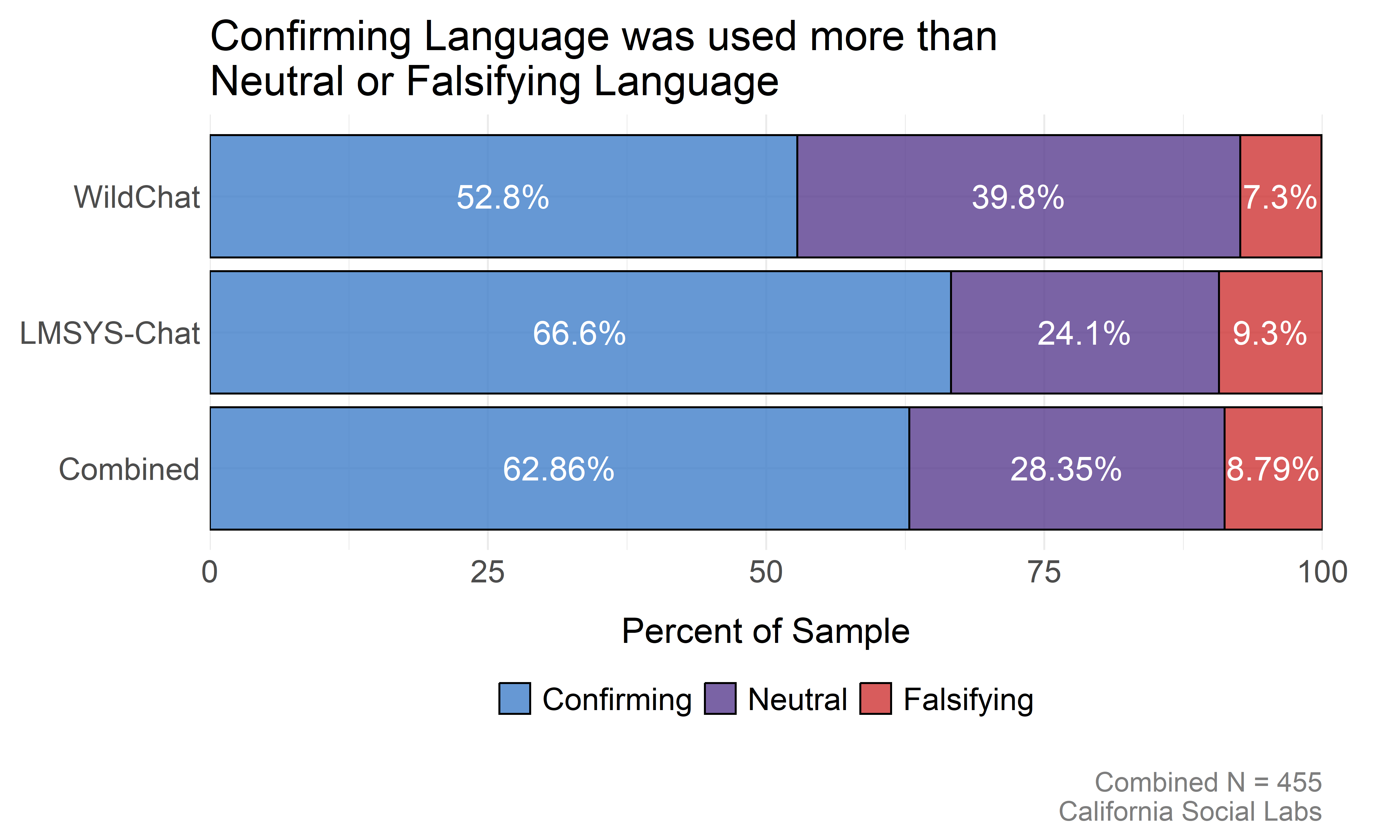
Of these 455 queries, 62.9% (n = 286) used confirming language, 28.4% (n = 129) used neutral or balanced language, and only 8.8% (n = 40) used falsifying language. To test a primary hypothesis that users preferentially seek belief-confirming over belief-falsifying information, I conducted a two-sided exact binomial test against an equal-preference null (p = .50). Users sought confirming information in 87.7% of directional queries (n = 286 confirming vs. n = 40 falsifying, corresponding to a 7.15-to-1 ratio of confirming to falsifying queries. Interestingly, this ratio was similar in both datasets.
I further classified conversations as related to economic policy (n = 62), social policy (n = 343), or general politics (n = 50). Note that Gemma overwhelmingly classified policy conversations as falling under social policy. Here is the breakdown of the pooled data by topic category:
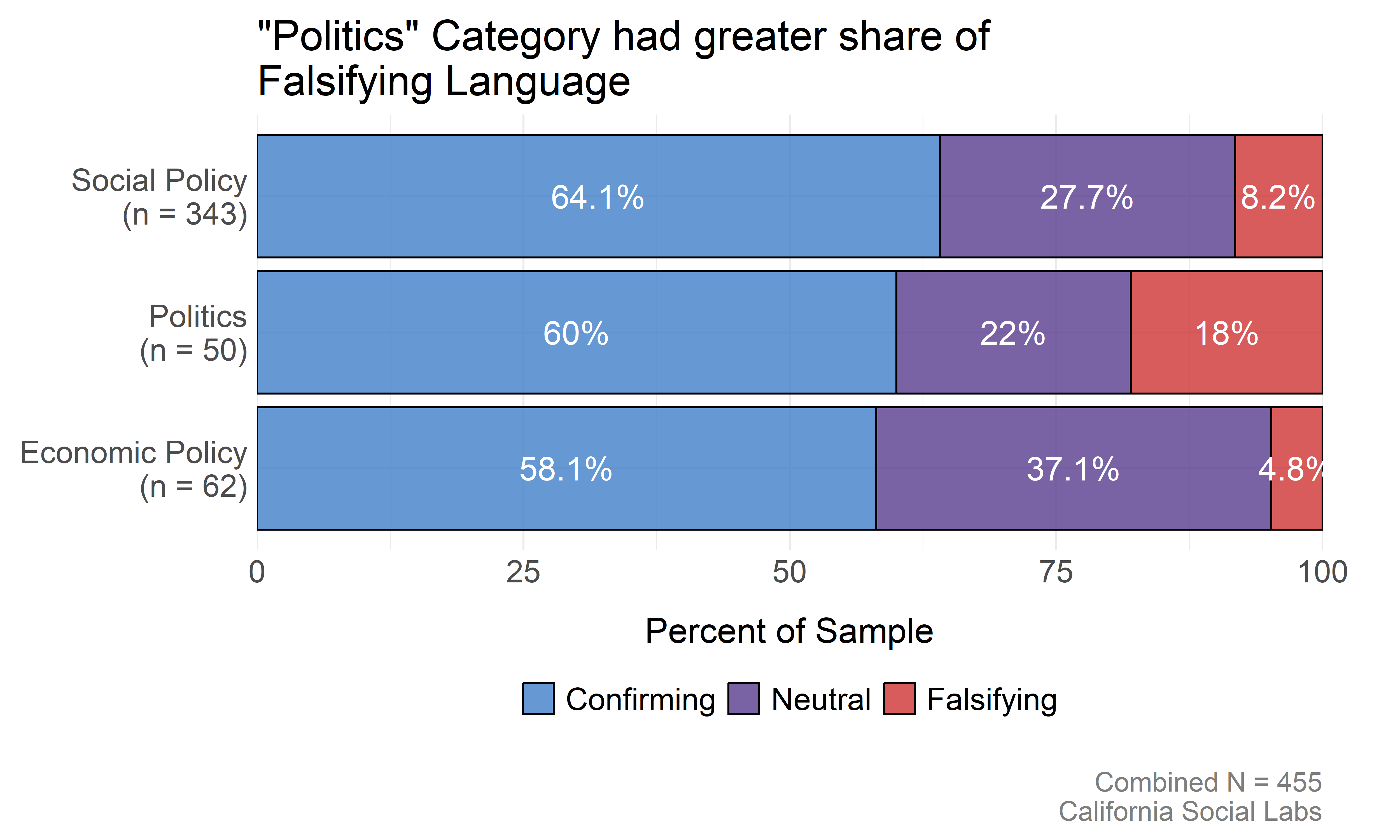
As seen, the politics category had a larger rate of falsifying language when compared to social or economic policy.
Overall, this secondary analysis demonstrates that people overuse confirming language when speaking with LLM chatbots about policy. It will be important to demonstrate this in a controlled experiment. This evidence is consistent with Sharma et al. (2024) 3 Sharma, N., Liao, Q. V., & Xiao, Z. (2024). Generative Echo Chamber? Effect of LLM-Powered Search Systems on Diverse Information Seeking. Proceedings of the 2024 CHI Conference on Human Factors in Computing Systems, CHI ’24, 1–17. https://doi.org/10.1145/3613904.3642459 , who compared confirmation bias in LLMs relative to general web searches. The authors found that LLM chats yielded more biased information searching when using LLMs. Further research could probe potential mechanisms related to selective exposure and information-seeking behavior with generative AI.
Data and code are available at https://github.com/CaliforniaSocialLabs/confirmation-bias-llms I drew the data from two large-scale public repositories on Hugging Face: LMSYS-Chat (1,000,000 conversations from LMSYS Chatbot Arena) and WildChat (1,000,000 user ChatGPT conversations), totaling 2,000,000 raw interactions. Because most LLM traffic involves coding, creative writing, or document processing, I first filtered each dataset for English conversations containing conversational user turns (20–2,000 characters) that posed an information-seeking question, matched political, economic, or social policy keywords, excluded code blocks and copy-pasted NLP/summarization templates, and deduplicated identical opening user prompts. From this pool of policy inquiries, we extracted candidate conversations using two complementary retrieval funnels on each dataset: (1) a lexical funnel requiring explicit first-person or normative belief phrases (e.g., "I think", "I believe", "in my opinion"), which yielded 1,021 candidates in LMSYS and 651 in WildChat, and (2) a semantic-embedding funnel that ranked policy questions without any belief-keyword requirement by cosine similarity to political-belief prototypes while penalizing similarity to homework or trivia tasks, retaining the top 1,000 candidates per dataset. Pooling and deduplicating overlapping conversations across both funnels yielded 3,489 unique candidate conversations (1,922 from LMSYS and 1,567 from WildChat). Each candidate was then evaluated on user turns only by a local language model (gemma4:12b temperature = 0.0, structured JSON schema) across a strict three-stage hierarchical rubric: Stage 1 verified that the user was genuinely discussing politics, social policy, or economic policy in their own voice (n=1,631 retained; 966 LMSYS, 665 WildChat); Stage 2 verified that the user stated a personal prior belief on the issue (n=537 retained; 387 LMSYS, 150 WildChat); and Stage 3 isolated the conversations in which the user posed an information-seeking query to explore, test, or validate that belief, resulting in our final analytic sample of N=455 conversations (332 from LMSYS and 123 from WildChat), each classified as confirming (n=286), neutral (n=129), or falsifying (n=40).
1 Zhao, W., Ren, X., Hessel, J., Cardie, C., Choi, Y., & Deng, Y. (2023, October 13). WildChat: 1M ChatGPT Interaction Logs in the Wild. The Twelfth International Conference on Learning Representations. https://openreview.net/forum?id=Bl8u7ZRlbM 2 Zheng, L., Chiang, W.-L., Sheng, Y., Li, T., Zhuang, S., Wu, Z., Zhuang, Y., Li, Z., Lin, Z., Xing, E. P., Gonzalez, J. E., Stoica, I., & Zhang, H. (2023). LMSYS-Chat-1M: A Large-Scale Real-World LLM Conversation Dataset. https://arxiv.org/abs/2309.11998v4 3 Sharma, N., Liao, Q. V., & Xiao, Z. (2024). Generative Echo Chamber? Effect of LLM-Powered Search Systems on Diverse Information Seeking. Proceedings of the 2024 CHI Conference on Human Factors in Computing Systems, CHI ’24, 1–17. https://doi.org/10.1145/3613904.3642459