Prediction Market Co-Betting Network in NBA Games
Brief Report April 28, 2026 by Clint McKenna
Prediction markets like Kalshi and Polymarket have become popular platforms for trading on future events, including sports outcomes. These markets allow users to buy and sell contracts based on the likelihood of specific events occurring, creating a real-time reflection of market sentiment and information aggregation that are generally market efficient among National Basketball Association (NBA) bets. 1 Yang, J., Cheng, G., & Zou, H. (2026). Arbitrage Analysis in Polymarket NBA Markets (SSRN Scholarly Paper No. 6624718). Social Science Research Network. Retrieved April 27, 2026, from https://papers.ssrn.com/sol3/papers.cfm?abstract_id=6624718 In this report, I examine who the top betters are on NBA games on Polymarket, and whether they behave like fans or traders.
The distinction matters. A fan-bettor places wagers driven by team loyalty and emotional attachment: they bet the Lakers because they like the Lakers, not because they've assessed the market odds. A trader-bettor treats prediction markets like a financial instrument, spreading positions across many teams and games in search of edge. These two archetypes imply very different things about market efficiency, platform sustainability, and the psychology of prediction market participation.
Each NBA moneyline market on Polymarket has two outcome tokens (one for each team). Holding a token is equivalent to having a bet on that team. I treat any wallet holding a non-zero position in a team's outcome token as a "bettor" on that team for that game. Position sizes were used to weight holder importance. For the network analysis, I aggregated each wallet's total position across all games in the 2025-2026 season for each team, then took the top 100 holders by cumulative position size per team. This ensures that the network captures committed, position-weighted bettors rather than wallets with trivial positions.
The Portfolio Overlap Betting Network
To measure behavioral similarity between team markets, I computed the Jaccard similarity index for each pair of teams:
$$J(A, B) = \frac{|A \cap B|}{|A \cup B|}$$
where A and B are the sets of top-100 position-weighted wallet addresses for teams A and B respectively. A Jaccard score of 0 means the two teams share no common top holders; a score of 1 means their top holder sets are identical.
This produces a 30×30 similarity matrix, which I represent as a weighted network where nodes are teams and edge weights are Jaccard similarities. I applied a threshold of 0.30 to retain only the strongest co-betting relationships, and used the Louvain community detection algorithm to identify clusters of teams whose markets share overlapping bettor bases.
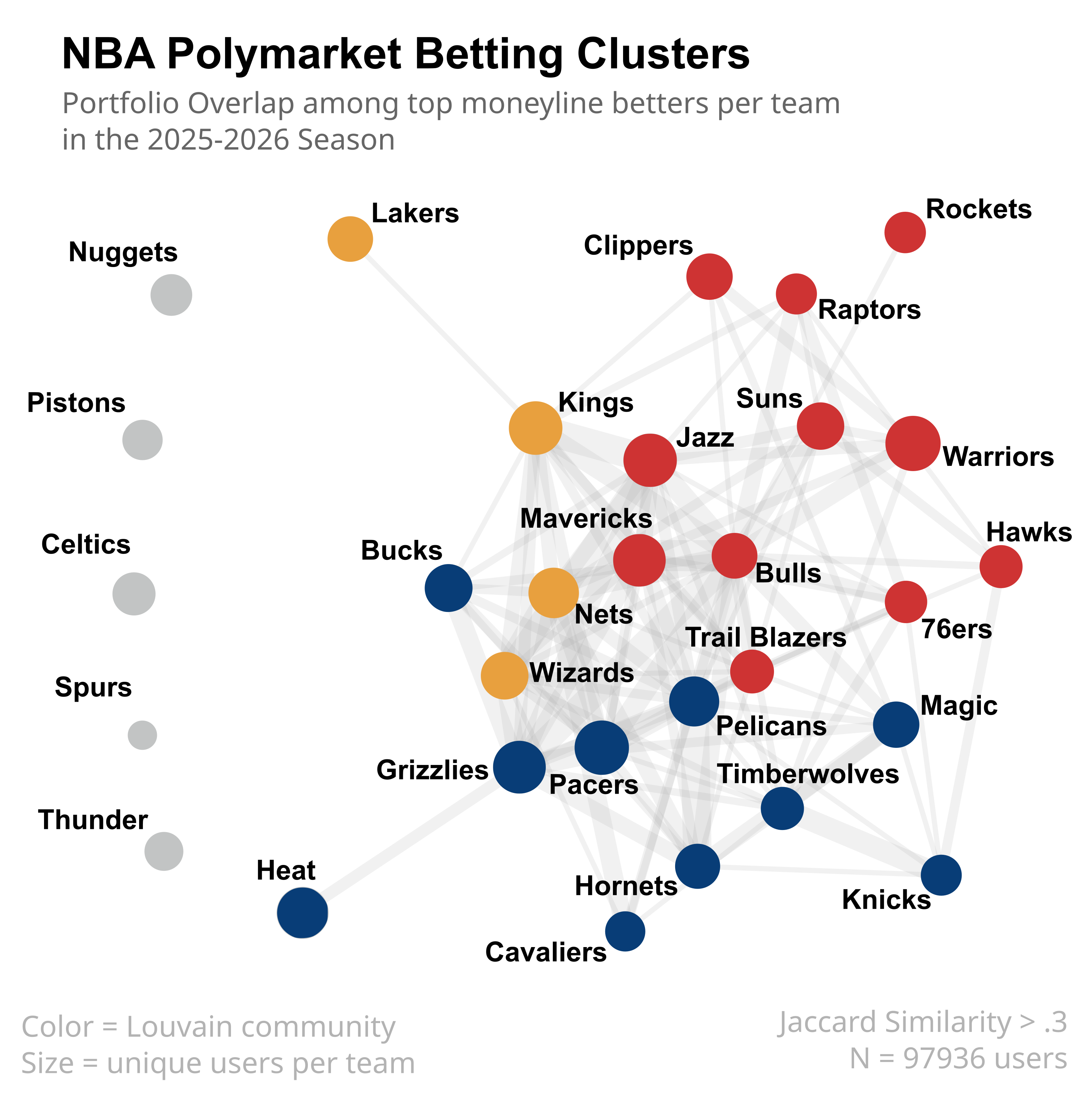
The co-betting network reveals a striking community structure that cuts across traditional ways of thinking about NBA team groupings. The 30 NBA teams fall into three distinct communities based on the overlap of their top bettor bases, plus a group of isolated teams with no strong co-betting relationships with any other team. Critically, conference affiliation does not drive the community structure. All three communities contain a mix of Eastern and Western Conference teams. Whatever is clustering these bettor bases together, it is not the geographical or competitive structure of the league.
The Isolated Teams
The most visually striking feature of the network is the cluster of gray isolated nodes — teams whose top bettor bases have less than 30% overlap with any other team in the league. This group includes some of the most prominent franchises in the NBA: the Nuggets, Pistons, Celtics, Spurs, and Thunder. Teams like the Lakers and Heat are also on the periphery of the network, suggesting that these teams might be represented more by one-time or casual bettors rather than active traders.
The Three Communities
The red community are mostly mid-tier competitive teams with engaged but not overwhelmingly large fanbases. The presence of the Warriors — one of the more popular NBA franchises — in this cluster rather than in the isolated periphery suggests that their Polymarket bettor base skews toward active traders rather than casual fans, possibly reflecting the team's strong following among the tech and crypto-adjacent demographic that dominates Polymarket's user base.
The orange community occupies a small middle ground: these teams have moderate co-betting overlap with each other but weaker connections to the red core. The Lakers appearing in this community rather than as an isolate is interesting; their enormous fan base apparently includes enough active traders to maintain some cross-market overlap, though their connections are weaker than the blue core teams.
The blue community is the most intriguing, with highly interconnected nodes. These are predominantly rebuilding or recently emergent teams — the Timberwolves and Cavaliers both had strong seasons in 2024-25, while the Magic and Knicks were compelling playoff stories. These may be teams that attracted a specific type of engaged bettor who was following compelling underdog or breakout narratives and cross-bet across similarly positioned teams.
Bettor Typology
To characterize individual bettor behavior across the season, I also classified each unique wallet into one of four phenotypes based on the number of distinct teams and games they participated in:
- One-time bettors: placed exactly one bet on one team across the entire season
- Loyalists: bet on the same team repeatedly but never bet on any other team
- Casual diversifiers: bet on 2–3 distinct teams across the season
- Active traders: bet on 4 or more distinct teams across the season
The population is sharply bifurcated.
| Bettor Type | % of Wallets | % of Volume |
|---|---|---|
| One-time | 40.7% | 4.9% |
| Casual diversifier | 26.2% | 7.7% |
| Loyalist | 0.6% | 0.09% |
| Active trader | 32.4% | 87.3% |
As seen above, Active traders — just 32% of wallets in the sample — account for 87% of all trading volume. This extreme concentration is consistent with the heavy-tail distributions observed in financial markets and online platforms more broadly, but the magnitude is striking. The prediction market ecosystem, at least for NBA betting, is economically dominated by a small core of highly active participants. By contrast, only 0.6% of wallets bet on a single team repeatedly without ever diversifying. 40% of participants are one-time bettors. This represents significant churn. Nearly half of all wallets that appear in the data placed a single bet and never returned. These are almost certainly casual fans drawn in by a specific game or media moment who did not sustain engagement with the platform.
Casual diversifiers occupy a middle ground. At 26% of wallets and 8% of volume, this group tried out a few different markets but never became deeply engaged. They may represent a conversion opportunity for the platform for users who showed some interest in diversified betting but didn't quite cross into active trading behavior.
The co-betting network, which is based on top-100 position-weighted holders, is almost entirely capturing the behavior of active traders. One-time bettors and loyalists are effectively filtered out by the position-weighting step. The network is therefore best understood as a map of the serious bettor community, the 32% of wallets responsible for nearly nine-tenths of all volume.
The teams in the dense blue core attract bettors who behave more like financial traders than sports fans. The high Jaccard similarities among these teams suggest that active traders are systematically spreading positions across the league, assessing each game on its merits rather than through the lens of team loyalty. The active trader community identified here is likely disproportionately responsible for whatever price efficiency exists in these markets. Consistent with top forecasters, these traders appear to be dispassionately evaluating each market rather than expressing any values towards a given team. 2 Mellers, B., Stone, E., Atanasov, P., Rohrbaugh, N., Metz, S. E., Ungar, L., Bishop, M. M., Horowitz, M., Merkle, E., & Tetlock, P. (2015). The psychology of intelligence analysis: Drivers of prediction accuracy in world politics. Journal of Experimental Psychology: Applied, 21(1), 1–14. https://doi.org/10.1037/xap0000040
Limitations
There are a few limitations of this analysis that might limit generalizability. First, polymarket's user base is crypto-based and skews toward technically sophisticated, financially literate participants. The fan vs. trader patterns observed here may be more extreme than what would be found on mainstream sports betting platforms with broader demographic reach. The top-100 position-weighted holder cutoff and the 0.30 Jaccard threshold are also analytical choices that shape the network structure. Alternative specifications may produce somewhat different community assignments. Finally, a single individual may control multiple wallet addresses, and a single wallet may represent multiple individuals (e.g., a shared account). Wallet-level analysis is an approximation of individual behavior.
Data and code are available at https://github.com/CaliforniaSocialLabs/polymarket-nba All data was collected from Polymarket's public API and on-chain records. For each NBA regular season game in the 2024-25 season, I identified the corresponding moneyline market — a simple binary bet on which team wins — and retrieved the top holders of each outcome token. In total I collected data from 1138 games spanning October 2025 through April 2026, representing 92.6% of the full regular season schedule. A small number of games had no corresponding Polymarket market or insufficient liquidity and were excluded. For each game, I retrieved up to 500 token holders per outcome, recording each holder's wallet address and position size in USDC. Network. Thet network was produced in R using ggraph using a stress algorithm. The community detection was done with igraph's Louvain algorithm. Nodes are colored by community and sized by number of users (wallet addresses).
1 Yang, J., Cheng, G., & Zou, H. (2026). Arbitrage Analysis in Polymarket NBA Markets (SSRN Scholarly Paper No. 6624718). Social Science Research Network. Retrieved April 27, 2026, from https://papers.ssrn.com/sol3/papers.cfm?abstract_id=6624718 2 Mellers, B., Stone, E., Atanasov, P., Rohrbaugh, N., Metz, S. E., Ungar, L., Bishop, M. M., Horowitz, M., Merkle, E., & Tetlock, P. (2015). The psychology of intelligence analysis: Drivers of prediction accuracy in world politics. Journal of Experimental Psychology: Applied, 21(1), 1–14. https://doi.org/10.1037/xap0000040